

How to Become a Data Scientist in 2025: A Step-by-Step Beginner’s Guide
-
Home
-
Data Science
-
How to Become a Data Scientist in 2025: A Step-by-Step Beginner’s Guide

How to Become a Data Scientist in 2025: A Step-by-Step Beginner’s Guide
Discover how to become a data scientist in 2025 with this complete beginner’s guide. Learn the skills, tools, platforms, and steps to land your first job in data science.

Table of Content
-
Why Data Science Is the Most Strategic Career Choice of 2025?
-
Understanding What a Data Scientist Really Does
-
Key Skills You Need to Succeed in Data Science
-
The Step-by-Step Learning Path for Beginners in 2025
-
Choosing the Right Courses and Platforms
-
Building a Job-Ready Data Science Portfolio
-
Tools and Technologies You Should Master in 2025
-
Certifications and Credentials That Matter
-
How to Gain Real-World Experience as a Beginner
-
How to Apply for Data Science Jobs (and Actually Get Hired)
-
The Future of Data Science: Trends You Can’t Ignore
-
Your Road Ahead: Making the Shift into a Full-Time Career
-
Join a Career-Aligned Data Science Program
-
FAQs

Why Data Science Is the Most Strategic Career Choice of 2025?
In 2025, the global digital landscape is driven by data, and the need to make sense of it has never been greater. Data is no longer just a by-product of business; it is the business itself. From healthcare and education to logistics and climate science, organizations now rely on data to make every meaningful decision. This surge has created a powerful demand for professionals who can analyze, interpret, and use data for innovation and growth.
Data science sits at the intersection of technology, business strategy, and human insight. It's not just about crunching numbers—it's about storytelling, ethical modeling, and predictive capabilities that drive decisions in real time. The acceleration of artificial intelligence, machine learning, and automation means that data scientists will not just support companies—they will lead them.
Moreover, with increasing access to affordable learning platforms, no-code tools, and beginner-friendly courses, 2025 has opened the door wider than ever before for newcomers. Whether you are a student, a working professional in another field, or someone returning to the workforce, data science offers an unmatched opportunity to step into a career that is future-proof, global, and deeply impactful.
1. Understanding What a Data Scientist Really Does

Before jumping in, it’s critical to understand what a data scientist truly does—and doesn't do. This role has evolved rapidly. Today, it is a blend of statistician, programmer, business analyst, and communicator. A data scientist collects raw data, cleans it, explores it to find patterns, builds predictive models, and tells stories with the data to influence business decisions.
A common misconception is that data scientists only work in tech companies. In reality, they’re found across all sectors—from healthcare to sports, finance to climate change organizations, and government to media. The daily work could range from writing Python scripts to analyze data, to using visualization tools to report findings to a marketing team, or building models that help businesses predict customer churn.
The core responsibilities typically include:
- Data acquisition and cleaning
- Exploratory data analysis (EDA)
- Statistical modeling and machine learning
- Data visualization and storytelling
- Deploying models for production use
- Working with cross-functional teams
It’s also important to distinguish this role from adjacent roles such as data analyst, machine learning engineer, or data engineer. While overlapping, each of these roles focuses on different stages of the data pipeline.

2. Key Skills You Need to Succeed in Data Science

Data science requires a blend of technical and non-technical skills. Many beginners focus only on the tech side, but that’s only half the equation. Employers increasingly seek professionals who can both code and communicate insights effectively.
Technical Skills:
- Programming Languages: Python (essential), R (optional), SQL (foundational)
- Statistics & Probability: Core statistical methods, hypothesis testing, distributions
- Machine Learning: Supervised and unsupervised learning, model evaluation
- Data Visualization: Using tools like Matplotlib, Seaborn, or Power BI
- Data Handling: Pandas, NumPy, working with large datasets
- Cloud Platforms: Google Cloud, AWS, or Azure knowledge is increasingly essential
Soft Skills:
- Critical Thinking: Asking the right questions
- Communication: Explaining data insights to non-technical teams
- Problem Solving: Addressing business challenges with data
- Collaboration: Working across departments and in agile teams
Building these skills takes time, but the good news is that you don’t need to master all of them before starting your journey. The path can be progressive and structured.

3. The Step-by-Step Learning Path for Beginners in 2025

Embarking on a data science journey in 2025 has never been more structured or beginner-friendly. Here’s a practical roadmap you can follow:
Step 1: Learn the Basics of Python and SQL
Begin with Python as it’s the industry standard. Learn how to write simple programs, work with lists, dictionaries, functions, and libraries. SQL will help you extract and query data from databases.
Step 2: Understand Statistics and Probability
Brush up on basic statistics—mean, median, variance, standard deviation, probability distributions, and hypothesis testing. These form the foundation of most data science models.
Step 3: Get Hands-On with Data Analysis and Visualization
Use datasets from Kaggle or UCI ML Repository. Practice data cleaning, manipulation with Pandas, and visualizing with Matplotlib or Seaborn.
Step 4: Learn Machine Learning
Start with linear and logistic regression, then progress to decision trees, random forests, and gradient boosting. Eventually, explore clustering and natural language processing.
Step 5: Build Real-World Projects
Apply your learning through end-to-end projects—such as predicting housing prices, classifying emails, or analyzing COVID-19 data trends.
Step 6: Create a GitHub Portfolio
Document your code and projects on GitHub. This acts as your proof of skill for employers and collaborators.

4. Choosing the Right Courses and Platforms

The platform you choose to learn data science can significantly influence your pace, motivation, and clarity. In 2025, there are three dominant types of platforms:
1. Massive Open Online Courses (MOOCs):
Examples: Coursera, edX, Udacity
- Offer university-certified programs
- Ideal for structured, academic learning
- Often come with capstone projects
2. Skill-Based Platforms:
Examples: DataCamp, Udemy, BISJHINTUS
- Focus on skill drills and mini-projects
- Cheaper and faster to complete
- Best for learners who need flexibility
3. Bootcamps and Mentorship-Based Programs:
Examples: Springboard, BISJHINTUS, Great Learning
- Offer direct mentorship, career services, and projects
- Higher cost, but faster career transition
- Ideal for job-seeking professionals
Make sure to pick based on your budget, learning style, and goals, not based on what’s trending.

5. Building a Job-Ready Data Science Portfolio

In 2025, a certificate alone isn’t enough. Employers want to see how you think, solve problems, and code. A strong data science portfolio can make or break your chances.
What to Include:
- 3–5 Real Projects: These should solve real-world problems using real datasets
- Diverse Topics: Include regression, classification, clustering, and NLP projects
- Clear ReadMe Docs: Explain the project purpose, data, models used, and results
- Visuals: Charts, graphs, dashboards (use Streamlit or Tableau)
- GitHub Repo: Keep all your code clean, commented, and pushed to GitHub
- Jupyter Notebooks: Make sure the notebooks are readable and interactive
Some example projects you can try:
- Predicting movie box office success
- Analyzing Airbnb pricing trends
- Sentiment analysis on Twitter data
- Customer churn prediction model
Your portfolio is your virtual résumé. Keep refining and updating it as you learn.

6. Tools and Technologies You Should Master in 2025

In 2025, the ecosystem for data science tools is vast but more accessible than ever. Rather than trying to learn everything, focus on mastering the most relevant and in-demand tools that will support your workflow from start to finish.
Core Programming and Analysis Tools:
- Python: Still the #1 language for data science
- Pandas & NumPy: For data manipulation and numerical analysis
- Matplotlib, Seaborn, Plotly: For visualization
- SQL: Essential for working with relational databases
- Jupyter Notebooks: Industry standard for prototyping and presenting work
Machine Learning Libraries:
- Scikit-learn: Most common for standard ML models
- XGBoost / LightGBM: For high-performance ML models
- TensorFlow / PyTorch: Used in deep learning and computer vision
- Hugging Face Transformers: Leading tools for NLP and generative AI
Cloud & Deployment Tools:
- Google Colab / Kaggle Kernels: Run notebooks without local setup
- AWS / GCP / Azure: Cloud computing platforms for large-scale projects
- Streamlit / Flask: To deploy your models into user-facing apps
Visualization & Reporting:
- Power BI / Tableau: For building executive-level dashboards
- Looker / Superset: Lightweight but powerful BI tools
The key is not to learn every tool, but to know which tool fits which task, and when to use it.

7. Certifications and Credentials That Matter

While a portfolio shows what you can do, certifications show your commitment to the craft. Not all certifications are equal, though. Focus on those that are recognized in the industry and teach real-world skills.
Top Certifications to Consider:
- Google Data Analytics Professional Certificate (Coursera)
- IBM Data Science Professional Certificate (Coursera)
- BISJHINTUS Data Science Career Program
- Microsoft Certified: Azure Data Scientist Associate
- AWS Certified Machine Learning – Specialty
- HarvardX Data Science Certificate (edX)
When choosing a certification:
- Look for hands-on projects
- Choose one that offers mentorship or career support, if possible
- Prioritize credibility and skill-building over brand hype
Remember, certifications can open doors—but it’s your skills and applied knowledge that get you hired.

8. How to Gain Real-World Experience as a Beginner

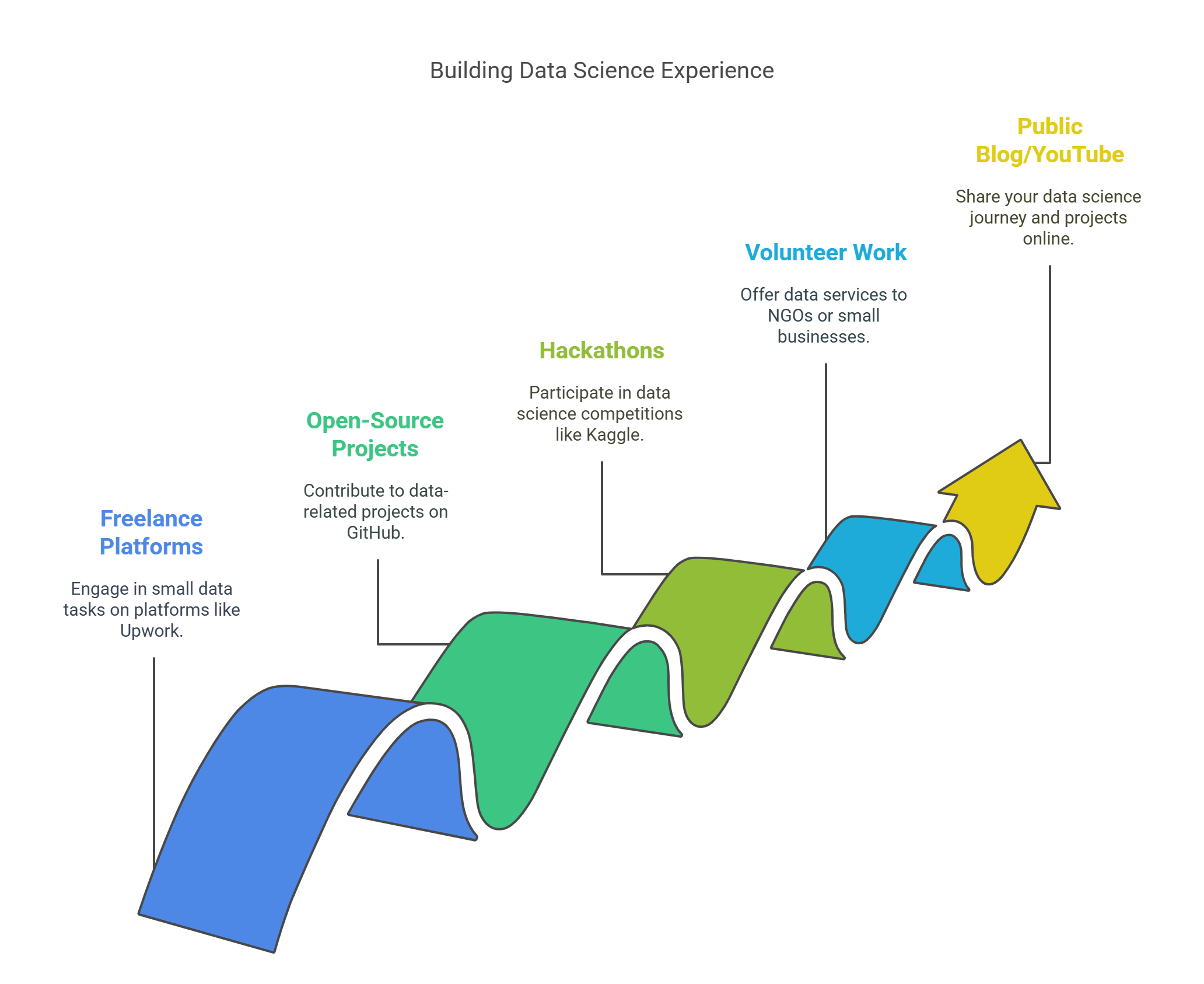
One of the biggest challenges beginners face is gaining experience before a job. Fortunately, 2025 offers several non-traditional ways to gain real-world practice.
Ways to Build Experience:
- Freelance on Platforms like Upwork, Toptal, or Fiverr: Take small data cleaning or visualization gigs
- Contribute to Open-Source Projects: Many GitHub repos need help with data processing or dashboards
- Join Hackathons (Kaggle, DrivenData, Zindi): These simulate real business problems and often lead to job opportunities
- Volunteer for NGOs or Small Businesses: Offer data services in exchange for experience and testimonials
- Start a Public Blog or YouTube Channel: Share your learning, projects, and insights—this builds credibility and network
Employers love to see self-initiative. The more you document your experience, the more confident they’ll feel about hiring you, even if you haven’t worked in data science formally yet.
9. How to Apply for Data Science Jobs (and Actually Get Hired)

Applying for data science jobs can feel overwhelming, especially with the competition. But a strategic approach helps you stand out.
Key Steps:
- Tailor Your Résumé: Focus on projects, skills, and measurable results. Use keywords from job listings.
- Build a Portfolio Website: Showcase your projects, GitHub links, blog posts, and resume in one place
- Leverage LinkedIn: Post about your learning journey, publish articles, and connect with recruiters in your industry
- Do Mock Interviews: Practice explaining your projects, code logic, and business impact
- Understand the Hiring Funnel: Prepare for technical tests (SQL, Python, ML), case studies, and behavioral interviews
Common Mistake:
Many candidates apply blindly to hundreds of roles. Instead, target 10–20 roles, tailor your applications, and network your way in. This method is more effective than mass applications.

10. The Future of Data Science: Trends You Can’t Ignore

Looking ahead, data science in 2025 and beyond is evolving fast. To stay ahead of the curve, you need to keep an eye on emerging trends.
Key Trends:
- Generative AI: Tools like ChatGPT, Claude, and Gemini are integrating with data science workflows
- No-Code / Low-Code Platforms: Tools like Dataiku, Alteryx, and AutoML reduce the need for deep coding
- Real-Time Data Processing: With Kafka and streaming APIs, decisions are now made instantly
- Data Governance & Ethics: With privacy laws growing, ethical data usage is a core requirement
- T-Shaped Professionals: Depth in data science + breadth in domain knowledge (e.g., healthcare, finance)
The ability to adapt to new tools and environments is what separates an average data scientist from a top-tier one.

Your Road Ahead: Making the Shift into a Full-Time Career

By now, you've explored the roadmap, skills, tools, and opportunities. What’s left is commitment. Data science is not a sprint—it’s a marathon. But unlike most marathons, you start seeing results early, even while learning.
Make a 6-month plan. Break it into weekly goals. Build, ship, and show your work. Keep learning from the community, follow industry voices, and never stop experimenting.
Thousands of professionals in 2025 are transitioning to data science from teaching, business, writing, and even law. If they can do it, so can you.
Your career in data science doesn’t begin when you get your first job. It begins today—when you start learning, practicing, and showing up.
Join a Career-Aligned Data Science Program

If you're ready to take your learning seriously and want a guided, outcome-focused experience, consider enrolling in a structured career program.
Why Join a Course Like BISJHINTUS Data Science Program?
- Live mentorship from industry experts
- Real-world capstone projects (with deployment)
- Career support: résumé, mock interviews, job referrals
- Portfolio & GitHub reviews
- Access to job communities and alumni network
Instead of navigating your path alone, join a program that aligns with your goals and supports your job transition from start to finish.
Enroll now at BISJHINTUS and transform your learning into a real career.
Frequently Asked Questions (FAQs)
1. Do I need a computer science degree to become a data scientist in 2025?
No. Many professionals today come from non-tech backgrounds and become data scientists by building portfolios and completing certifications.
2. How long does it take to become job-ready in data science?
With consistent effort, you can become job-ready in 6–9 months through structured learning, hands-on practice, and portfolio building.
3. Is coding mandatory for data science in 2025?
Basic coding in Python and SQL is essential, but many no-code tools are emerging. Still, foundational programming helps you advance faster.
4. Can I get a remote data science job as a beginner?
Yes. Many companies hire junior data scientists remotely, especially if you show initiative through projects and GitHub profiles.
5. What are the highest-paying data science roles in 2025?
Machine Learning Engineer, Data Architect, and AI Product Manager are among the highest-paying, depending on your specialization.
Written By
Critical Legal Writer Intern at BISJHINTUS, English Honours (Gold Medalist) / LL.B.

Designed By
UI/UX Designer at BISJHINTUS

Share this post:
Leave a comment
Your email address will not be published. Required fields are marked *
Write a Review
Related Posts
Confused between data science and data analytics? This in-depth 2025 comparison guide breaks down sk...
Discover why 2025 is the ideal time to start your data science journey. Learn about job trends, sala...
